
 By
By 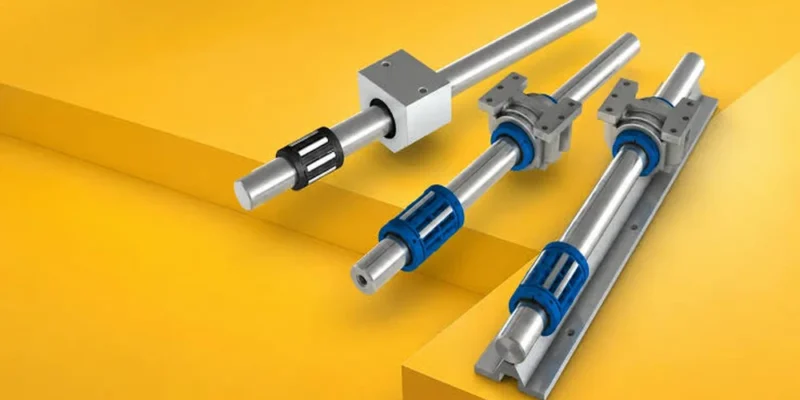
Pairing a linear bearing on a smooth shaft (ลูกปืนสไลด์บนเพลาเกลี้ยง) requires much more than just matching diameters. Since the internal steel balls make direct contact during movement, the shaft effectively acts as the mechanism’s inner race. Selecting incorrect materials, inadequate hardness, or imprecise tolerances immediately triggers excessive friction and premature wear. Understanding these critical technical specifications is essential to ensure smooth operation, maintain precision, and prevent costly machine downtime.
Types of Shafts Compatible with Linear Bearings
Hardened Steel Shafts (SUJ2 or equivalent)
This is the industry standard for general automation. Manufactured from high-carbon bearing steel, these shafts undergo high-frequency induction hardening to achieve a deep, uniform hard case. This allows them to withstand continuous point-contact stress without deforming. While highly cost-effective, they require regular lubrication to prevent rust in standard environments.
Stainless Steel Shafts (SUS440C)
When applications demand stringent hygiene or face harsh environmental factors, stainless steel is essential. SUS440C (martensitic stainless steel) is specifically used because it can be heat-treated to reach the necessary hardness for ball bearing contact, unlike standard 304. It offers superior corrosion resistance, making it ideal for cleanrooms, medical device manufacturing, and food processing facilities.
Hard Chrome-Plated Shafts
These provide an optimal balance between wear resistance and environmental protection. A layer of hard chrome is electroplated onto a steel core, offering exceptional surface hardness and a low coefficient of friction. This acts as a robust barrier against rust, making these shafts highly suitable for outdoor operations or high-humidity areas.
Why Checking Specifications is Crucial
Surface Hardness (HRC 58-64)
The shaft must possess a minimum surface hardness of HRC 58. If the material is too soft, the rolling balls will cause plastic deformation-carving permanent grooves (brinelling) into the metal over time. This ruins the linear motion, causing vibration and catastrophic system failure.
Dimensional Tolerance (g6 or h7)
Shafts must be machined to strict outer diameter tolerances to ensure the exact micro-millimeter clearance between the bearing and the shaft. An oversized shaft will cause heavy binding, overheating, and immediate lock-up, while an undersized shaft leads to excessive radial play and loss of positioning accuracy.
Surface Roughness (Ra)
A highly polished surface with a low roughness value (typically Ra 0.2 to 0.4 µm) is mandatory. A smoother surface drastically minimizes friction, reduces operational noise, and prevents the premature degradation of internal seals, ultimately extending the system’s overall lifespan.
Selecting the correct shaft configuration directly dictates the mechanical efficiency of your machinery. Always cross-reference hardness, dimensional tolerance, and material specifications before making a purchase. For high-quality motion components tailored to precise engineering needs, explore the linear bearing on smooth shaft solutions from I.N.B to ensure optimal, long-lasting performance.






Comments